
How to Plan a Corporate Retreat That Actually Drives Results
Corporate retreat planning has become essential for organizations dealing with hybrid workforces and distributed teams. Companies are waking up to the fact that disengaged employees cost them $16,000 annually per person. Structured offsite experiences now tackle real business problems that go way beyond basic team bonding.
Today's retreats create focused environments where teams can rebuild trust, get aligned on what matters most, and develop communication habits that actually stick when they're back at work. The investment delivers real results: Deloitte found a 73% drop in employee turnover for companies with solid team bonding strategies. McKinsey shows that well-connected teams are 25% more productive.
About the Author: Carly Caminiti is a leadership coach specializing in team dynamics and professional development, with extensive experience facilitating corporate retreats for organizations ranging from 20 to 200+ participants. Her work focuses on transforming team cohesion and communication patterns through intentional offsite experiences that address the deeper interpersonal dynamics remote work often obscures.
Also Read:
Table of Contents
TL;DR: Corporate Retreat Planning Guide
Corporate retreat planning is no longer about team bonding, it's a strategic investment that improves alignment, strengthens communication, and boosts productivity long after the event ends. The most successful retreats start with clear objectives, measurable outcomes, a realistic planning timeline, and intentional agenda design that balances work with meaningful connection. Choosing the right venue, managing logistics with precision, and building in deliberate unstructured time dramatically increase impact. When organizations plan retreats around trust, clarity, and team dynamics, the return on investment is substantial, with companies reporting improved retention, higher engagement, and a stronger sense of unity across distributed teams.
Key Points
Allied Market Research projects the corporate retreats market will hit $38.4 billion by 2027 and $73.7 billion by 2034, showing serious institutional confidence in retreat ROI
Start planning 3-6 months ahead for retreats under 100 people, with average retreat lengths of 3.78 days according to surveys of 210 companies
62% of companies now host destination retreats outside their main location, with beachside venues capturing 54% of preferences
Smart agenda design balances structured sessions with unstructured connection time. Over-scheduling kills the informal relationship building that creates lasting impact
Professional retreat planners cut down errors and get better vendor rates. The hidden costs of internal planning often exceed professional fees
Why Corporate Retreats Matter
The financial returns are hard to ignore. Organizations that properly track team building investments see a $4 return for every $1 invested. More comprehensive programs document returns as high as 7.5x through layered approaches that combine wellness, professional development, and strategic planning.
Deloitte's research shows that companies with strong team bonding strategies see a 73% decrease in employee turnover. When replacing a mid-level manager costs $75,000-$150,000, preventing even one departure usually pays for the entire retreat budget.
McKinsey research demonstrates that well-connected teams are 25% more productive. Strategic programs built around measurable goals deliver up to a 14% boost in productivity when they focus on trust, communication, and leadership development.
Types of Corporate Retreats and When to Use Each
Strategy retreats bring leadership together to define vision and align on major initiatives. They feature focused work sessions with minimal recreational programming. Team building retreats prioritize relationship development and cultural cohesion, balancing collaborative activities with structured reflection.
Professional development retreats combine skill-building with strategic planning. They work particularly well when teams face new challenges requiring expanded capabilities. Hybrid retreats blend virtual and in-person elements to accommodate distributed teams, with 91% of offsite organizers now operating in remote or hybrid models.
Define Your Retreat Objectives and Success Metrics
Clear objectives transform retreats from expensive outings into strategic investments. Without defined outcomes, planning becomes directionless and measuring success becomes impossible.
Align Retreat Goals with Business Priorities
Effective retreat objectives connect directly to organizational challenges. Rather than generic goals like "improve teamwork," successful planners identify specific gaps: cross-functional collaboration breakdowns, misalignment on quarterly priorities, or communication patterns undermining productivity.
Team cohesion requires intentional design around trust and psychological safety. Retreats create concentrated opportunities to address interpersonal dynamics that remote work obscures. When teams struggle with unclear boundaries or hesitation to voice concerns, structured offsite time provides the container for meaningful shifts.
Leadership involvement proves critical. When executives participate in defining retreat goals and communicate their importance beforehand, attendance rates improve and engagement deepens.
Identify Key Outcomes and How to Measure Them
Measurable outcomes distinguish strategic retreats from generic team events. Strong metrics include specific behavioral changes, documented decisions, or tracked follow-through on action items.
A sales team established S.M.A.R.T. goals during their offsite, targeting four additional sales monthly per person. At a $1,000 per-person retreat cost, the team achieved $500 per person in monthly ROI within three months. That translates to a $6,000 per-person annual ROI.
Document baseline measurements before the event to enable accurate post-retreat comparison. Track retention improvements, engagement scores, or progress against strategic initiatives launched during the retreat.
Build Your Planning Timeline and Budget
Strategic timing and realistic budgets form the foundation of successful retreat execution.
How Far in Advance to Start Planning
Industry experts recommend a 3-month planning window for retreats under 100 guests. This divides naturally into venue research and contracts (month one), activities and restaurant selection (month two), and programming refinement (month three). Larger retreats or destination events require 6-9 months as popular venues book well ahead.
Common challenges emerge when planners underestimate coordination complexity. One retreat organizer for a 75-person offsite discovered their preferred mountain venue was booked solid when they started planning just eight weeks out. Shifting to a less desirable backup location with limited hiking access disappointed outdoors-oriented attendees, while rush booking fees added 25% to their transportation costs.
Send save-the-dates 3-6 months in advance to maximize attendance, allowing employees to manage schedules and reduce conflicts.
Create a Realistic Retreat Budget
Budget realism starts with understanding your organization's constraints and priorities. According to surveys of 210 companies, the average retreat spend for companies with 21-50 employees was $3,692 per person including flights and accommodations, with retreats averaging 3.78 days.
Allied Market Research projects the global corporate retreats market to reach $38.4 billion by 2027 in the short term and $73.7 billion by 2034, growing at a 9.1% compound annual growth rate. This reflects growing institutional confidence across technology, finance, and professional services sectors.
Fixed vs. Variable Costs to Consider
Fixed costs include venue rental, meeting space fees, AV equipment, and facilitator fees. These stay constant regardless of final attendance. Variable costs scale with participant count: accommodations, meals, individual activity fees, and transportation per person.
Build a contingency reserve of 10-15% to handle unexpected expenses without compromising essential elements. One HR director planning their first retreat budgeted precisely to their $30,000 allocation but encountered $4,500 in unanticipated expenses: rush printing for materials they'd forgotten ($800), additional vegetarian meal upgrades when three participants reported new dietary restrictions ($600), emergency AV equipment rental when the venue's projector failed ($1,200), and upgraded transportation when their group size increased from 38 to 42 participants ($1,900). Without contingency funds, they absorbed costs from their department's training budget.
Common Budget Pitfalls and How to Avoid Them
Request comprehensive pricing including setup fees, service charges, and required minimums before committing. Survey participants early about dietary restrictions and accessibility needs to budget accurately.
The biggest hidden cost emerges when internal staff manages retreat planning alongside regular responsibilities. Time spent coordinating hundreds of details diverts attention from core work, creating opportunity costs that exceed professional planner fees.
Select the Perfect Venue and Location
Venue selection dramatically influences retreat effectiveness, balancing accessibility with genuine escape from typical work environments.
Onsite, Offsite, or Destination: Choosing Your Format
Onsite retreats at company facilities minimize costs but rarely deliver the psychological separation that drives breakthrough thinking. Local offsite venues within an hour of your primary office offer cost-effective middle ground, providing fresh environments without extensive travel logistics.
Destination retreats dominate current preferences, with 62% of companies hosting offsites in countries outside their primary location. These formats create memorable experiences that strengthen team bonds through shared adventure.
Webflow, a remote web development company, executed a week-long retreat for their entire global team of 120 people at Mayakoba, Mexico, with main focuses on strategy and bonding. Similarly, Salesloft organized an ambitious 3-day retreat bringing together nearly 400 employees from across North America to Playa Mujeres, demonstrating how companies successfully execute large-scale destination events.
Beachside retreats capture 54% of company preferences, but countryside settings have seen a remarkable 308% increase in popularity between 2023 and 2024.
Essential Venue Criteria and Deal-Breakers
Prioritize venues offering dedicated meeting spaces with reliable technology infrastructure. Video conferencing capabilities, strong Wi-Fi, and adaptable room configurations support diverse session formats.
Accommodation quality directly impacts engagement. Comfortable sleeping arrangements, adequate common spaces for informal conversation, and proximity to meeting areas reduce friction and maintain energy throughout multi-day events.
Accessibility matters for inclusive participation. Ensure venues accommodate varying mobility levels, dietary needs, and sensory preferences. Request detailed accessibility information before site visits to avoid discovering limitations after commitment.
Site Visit Checklist and Questions to Ask
Schedule site visits for finalist venues to evaluate fit accurately. Walk through meeting spaces during similar timeframes to your planned sessions, testing acoustics and natural light conditions.
Verify exact room capacities for your group size in various configurations: theater style for presentations, rounds for discussion, and breakout spaces for small groups. Stated capacity numbers often assume tighter spacing than comfortable learning requires.
Test the venue's responsiveness during the inquiry process. Organizations that respond slowly to questions or provide incomplete information often deliver similarly during events.
Design an Agenda That Balances Work and Connection
Strategic agenda design creates rhythm that sustains engagement while accomplishing retreat objectives.
Structure Your Retreat Schedule for Maximum Engagement
Open with a session establishing psychological safety and shared purpose. Establishing clear boundaries and expectations upfront creates containers where authentic contribution flourishes.
Schedule high-focus strategic sessions when energy peaks, typically mid-morning and early afternoon. Reserve early mornings for lighter team building or physical activities that gradually raise engagement levels.
Build meaningful transitions between sessions rather than back-to-back programming. Even 15-minute breaks allow processing time and informal conversation that often generates insights matching formal discussions.
Balance Strategic Sessions with Team Building Activities
Effective agendas alternate between focused work and connective experiences. A learning and development firm invested $50,000 to host a five-day immersive wellness retreat incorporating nature immersion, somatic learning, and conscious communication. The retreat delivered a 7.5x return on investment through 25% retention improvement, 5.6% productivity gains, and 29.5% stress reduction, with results sustained six months later.
Match activity intensity to group composition and timing. Reserve physically demanding options for early in multi-day retreats when energy runs high. Prioritize inclusive activities that accommodate varying fitness levels and mobility.
Leave Room for Unstructured Time and Spontaneous Connections
Over-scheduling represents the most common agenda design mistake. Professional retreat facilitators emphasize that teams need deliberate unstructured time built into agendas, as research applying the Job Demands-Resources framework found that incorporating unstructured time increased psychological safety and engagement.
Schedule extended meal periods without formal programming. Breakfast and dinner particularly lend themselves to free-flowing conversation that builds relationships deeper than structured activities typically achieve.
Consider designating free afternoons or evenings where participants choose their engagement level. Some will continue informal work discussions, others explore the local area, and many will form spontaneous small groups around shared interests.

Plan Team Building Activities That Resonate
Team building activities accelerate connection when thoughtfully selected and skillfully facilitated.
Match Activities to Your Team Culture and Retreat Goals
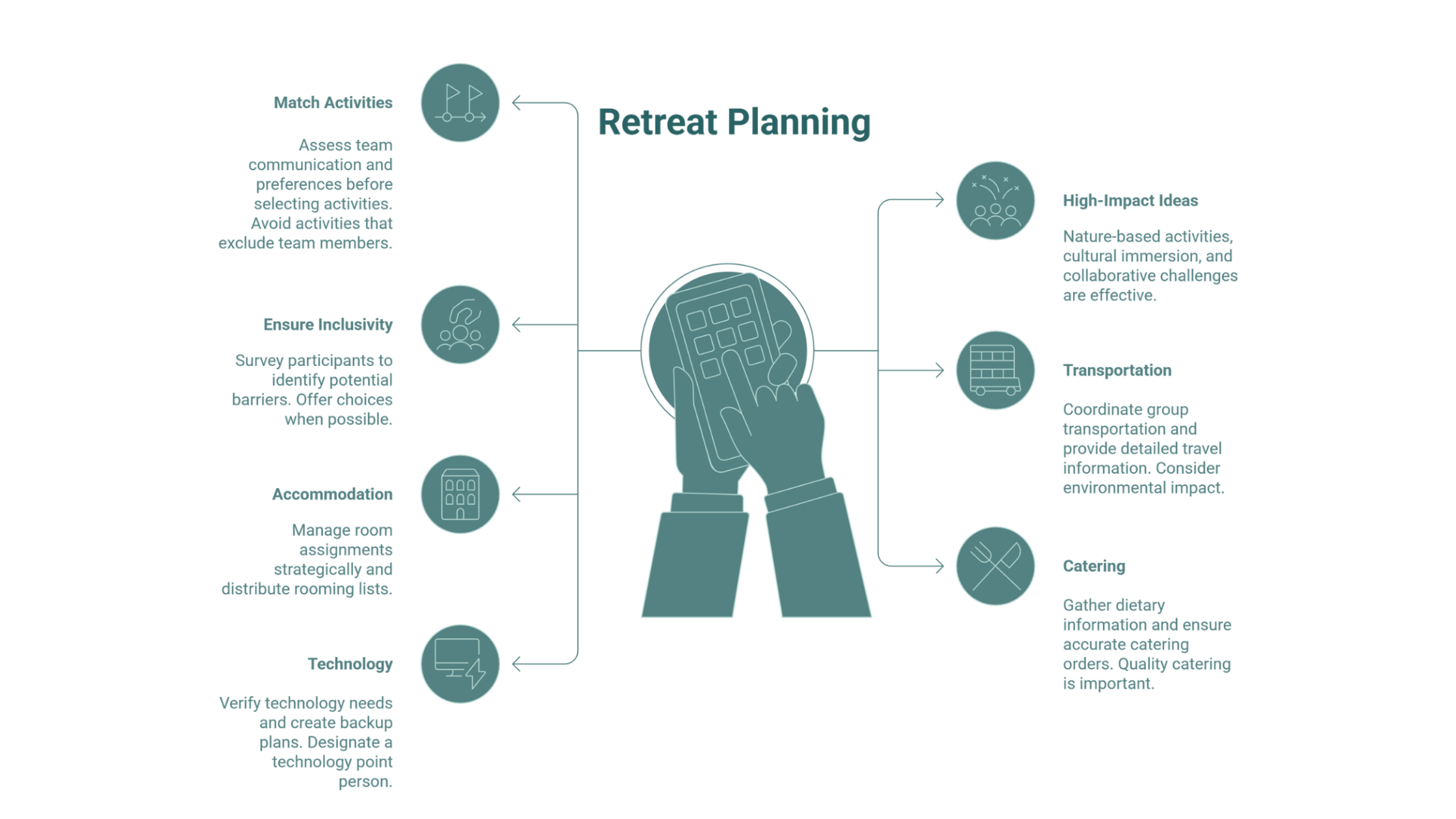
Assess your team's communication style and preferences before selecting activities. Highly analytical teams may engage better with problem-solving challenges than purely social exercises. Creative teams often appreciate activities allowing individual expression within collaborative contexts.
Avoid activities that inadvertently exclude team members. Physical challenges disadvantage those with mobility limitations. Highly competitive formats can alienate collaborative team members uncomfortable with aggressive interactions.
High-Impact Team Building Ideas
Nature-based activities deliver measurable benefits, with McKinsey research finding that spending time in nature improves cognitive functioning and boosts team connections. Options include guided hikes with reflection prompts, outdoor problem-solving courses, or conservation projects that combine purpose with collaboration.
Cultural immersion experiences work particularly well for destination retreats. Cooking classes featuring local cuisine, artisan workshops, or community service projects create shared memories while exposing teams to new perspectives.
Collaborative challenges requiring coordination surface communication patterns and decision-making dynamics. Escape rooms, strategy simulations, or design thinking exercises reveal how teams naturally organize and can identify improvement opportunities.
Ensure Activities Are Inclusive and Accessible
Survey participants before finalizing activities to identify potential barriers. Ask about mobility considerations, sensory sensitivities, dietary restrictions, and personal preferences. This information allows selecting activities everyone can meaningfully engage with.
Offer choice when possible. Presenting two or three activity options for free time periods respects diverse preferences while maintaining shared experiences.
Manage Logistics and Operations
Flawless logistics allow participants to focus on retreat content rather than operational concerns.
Transportation and Travel Arrangements
Coordinate group transportation when possible to build connection during travel and simplify logistics. For destination retreats, provide detailed travel information including flight recommendations, ground transportation options, and arrival procedures.
Consider environmental impact when planning transportation. Consolidated travel reduces carbon footprint and often costs less than individual arrangements.
Accommodation Coordination and Rooming Lists
Manage room assignments strategically to support retreat goals. Single occupancy allows needed downtime in multi-day retreats, though shared rooms reduce costs for budget-conscious organizations.
Distribute rooming lists and check-in procedures well before arrival. Clear communication about accommodation locations, check-in times, and room amenities reduces day-of confusion.
Catering and Dietary Accommodations
Gather comprehensive dietary information during registration, asking specifically about allergies, religious restrictions, preferences, and quantities to ensure accurate catering orders.
Quality catering matters more than luxury options. Well-prepared, appropriately portioned meals that accommodate all dietary needs demonstrate respect for participants and maintain energy throughout programming.
Technology and AV Requirements
Verify technology needs for each session and confirm venue capabilities match requirements. Create technology backup plans for critical sessions, having offline versions of presentations available and backup devices ready.
Designate a technology point person who troubleshoots issues quickly without disrupting programming flow.
Communicate Effectively Before, During, and After
Strategic communication builds excitement before retreats, maintains engagement during events, and ensures follow-through afterward.
Pre-Retreat Communication: Build Excitement and Clarity
Send initial announcements 3-6 months before the retreat establishing dates and general purpose. Follow with detailed participant packages 4-6 weeks before departure covering retreat objectives, detailed agendas, logistics information, packing suggestions, and what to expect.
Gather input through pre-retreat surveys asking about topics of interest, questions participants want addressed, and what success looks like to them. This engagement increases investment and allows agenda refinement based on actual needs.
During the Retreat: Keep Everyone Informed and Engaged
Provide daily schedule updates each evening covering the next day's activities, timing, locations, and any changes from original plans. Designate a single point person handling questions and coordinating real-time adjustments.
Document decisions and commitments in real-time rather than relying on post-retreat reconstruction. Visible documentation creates accountability and ensures nothing gets lost in transition back to daily operations.
Post-Retreat Follow-Up and Action Items
Send immediate follow-up within 48-72 hours thanking participants and sharing initial takeaways. Distribute comprehensive recap documents including decisions made, action items with owners and deadlines, key insights captured, and next steps.
Schedule follow-up sessions at 30 and 90 days to review progress on retreat-generated initiatives. Regular check-ins demonstrate seriousness about implementation and provide forums for addressing obstacles.

Execute a Flawless Retreat Experience
Skilled execution transforms careful planning into memorable experiences that deliver intended outcomes.
Day-Of Coordination Checklist
Arrive early to verify all logistical elements: room setup matches requirements, technology functions properly, catering deliveries align with schedule, and materials are organized and accessible.
Conduct brief coordination meetings with venue staff, facilitators, and activity providers confirming timing, expectations, and communication protocols.
Lessons from the Field: Real Challenges and Solutions
Challenge: Weather Disruption A tech company's planned outdoor team challenge got cancelled when unexpected thunderstorms rolled in during their mountain retreat. Their backup plan involved transforming the main conference room into an indoor "innovation lab" where teams used craft supplies to prototype solutions to real company challenges. The shift actually generated more actionable insights than the original outdoor activity would have. The relaxed creative atmosphere helped quieter team members contribute more freely.
Challenge: Dietary Restriction Discovery During check-in for a 50-person retreat, three participants mentioned severe food allergies not captured in the pre-event survey. The retreat coordinator immediately contacted the venue kitchen, worked with the chef to modify planned meals, and arranged alternative vendors for items the venue couldn't accommodate. The coordinator kept affected participants informed at each meal about which dishes were safe. The attention to their needs became a highlight they mentioned in post-retreat feedback.
Challenge: Technology Failure During Critical Session Fifteen minutes before a strategic planning session requiring video conferencing with remote team members, the venue's internet connection failed completely. The facilitator had downloaded offline versions of all presentations and printed key discussion materials. They restructured the session into smaller breakout discussions that didn't require technology, documented outcomes on flip charts, and scheduled a follow-up virtual session the next week for remote participants to engage with the conclusions. The analog approach actually encouraged deeper discussion than the planned format.
Challenge: Participant Conflict Surfacing Mid-retreat tensions between two department heads escalated during a team activity, creating awkward tension across the group. The facilitator called a break, met briefly with both individuals separately to understand the underlying issues, then facilitated a structured conversation acknowledging the conflict while redirecting toward shared goals. Rather than pretending the tension didn't exist, addressing it directly demonstrated that the retreat was a safe space for authentic dialogue. Several other participants later mentioned appreciating the honest approach.
Create Memorable Moments and Signature Experiences
Design intentional moments that become shared reference points for your team. EvenUp Law achieved 96% satisfaction among 365 employees in vibrant Montreal by maximizing budget efficiency while creating meaningful experiences, demonstrating that strong results don't require premium international destinations.
Personalize experiences when possible. Acknowledging individual contributions, celebrating milestones, or incorporating elements reflecting team history and culture makes retreats feel custom-designed rather than generic.
Measure Success and Gather Actionable Feedback
Systematic evaluation transforms retreat experiences into organizational learning and continuous improvement.
Collect Feedback During and After the Retreat
Deploy real-time pulse checks during the retreat through quick digital surveys or group discussions, allowing mid-course corrections. Distribute comprehensive post-retreat surveys within 48 hours addressing all retreat elements: pre-event communication, content quality, facilitation effectiveness, logistics, activities, and overall value.
Conduct small group debrief sessions exploring deeper themes that surveys miss, revealing nuanced insights about team dynamics and unintended outcomes.
Analyze ROI and Impact on Team Performance
Track leading indicators in the 90 days following retreats: engagement scores, retention rates, cross-functional collaboration frequency, and progress against strategic initiatives launched during the retreat.
Compare baseline measurements taken before the retreat against post-retreat performance. Calculate financial returns using frameworks like revenue impact from strategic initiatives, cost savings from improved retention, or productivity gains from enhanced collaboration.
Document Lessons Learned for Future Retreats
Create comprehensive post-mortem documents capturing what worked well, what fell short, and specific recommendations for improvement. Store all planning documents, timelines, budgets, and vendor contacts in accessible locations for future planning teams.
Share learnings across your organization to benefit other teams planning retreats. Collective learning accelerates quality improvements and prevents repeated mistakes.
When to Hire a Professional Retreat Planner
Professional planning support often delivers better outcomes than in-house coordination for complex retreats.
Signs You Need Expert Support
Large participant numbers exceeding 50 people create complexity that overwhelms most internal teams. Professional planners manage detailed logistics, vendor coordination, and real-time problem-solving more efficiently than staff juggling retreats alongside regular responsibilities.
Destination retreats involving international travel benefit substantially from professional expertise. Planners' established vendor networks and local knowledge prevent costly mistakes and access opportunities internal teams wouldn't discover.
Limited internal bandwidth signals the need for external support. When staff manages retreats while handling core responsibilities, quality suffers across all work. First-time retreat planning involves steep learning curves, and professional guidance helps avoid common pitfalls while building internal capability for future events.
What Professional Retreat Planners Provide
Expert planners bring extensive vendor networks built over years of relationship development. These connections often secure better rates and access unique venues or experiences, frequently offsetting fees through savings they negotiate.
Comprehensive logistics management covers every detail from venue contracts through post-retreat follow-up. Professional planners coordinate transportation, accommodations, catering, technology, activities, and contingency planning.
Strategic design expertise helps align retreat programming with business objectives. Experienced planners structure agendas balancing productivity with engagement, select activities matching team culture, and facilitate sessions driving toward defined outcomes.
The biggest benefit is transforming from coordinator to participant, allowing you to focus on your team and retreat goals instead of operational details.
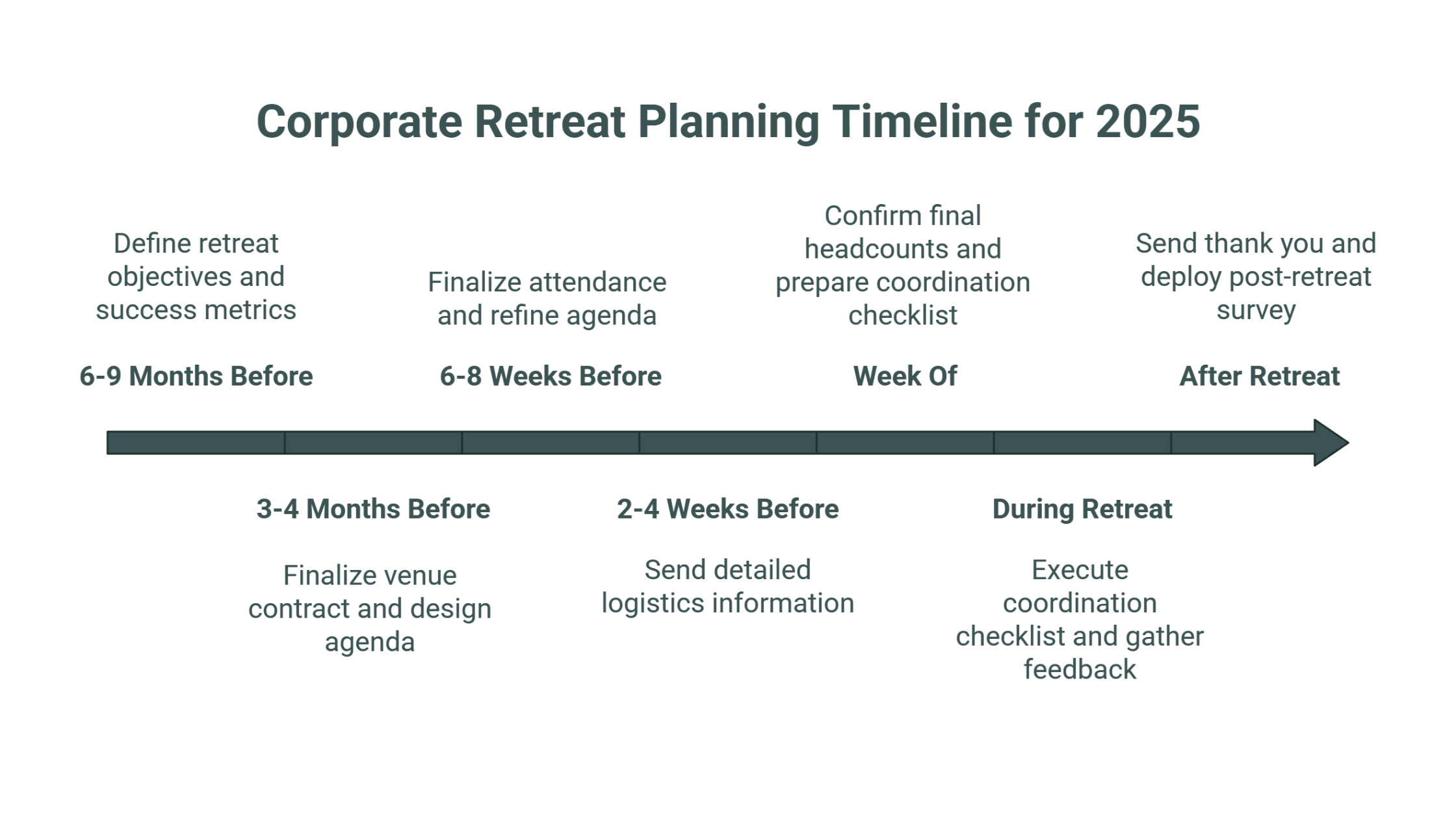
Your Corporate Retreat Planning Checklist
6-9 Months Before:
Define retreat objectives and success metrics
Secure leadership buy-in
Establish preliminary budget
Begin venue research and site visits
Send save-the-dates
3-4 Months Before:
Finalize venue contract
Design detailed agenda
Select and book activities
Coordinate facilitator or professional planner if needed
Distribute participant information packages
6-8 Weeks Before:
Finalize attendance and collect dietary requirements
Confirm all vendor contracts
Complete accommodation rooming lists
Gather pre-retreat survey input
Refine agenda based on feedback
2-4 Weeks Before:
Send detailed logistics information
Confirm technology and AV requirements
Prepare materials and handouts
Coordinate transportation arrangements
Conduct final venue walkthrough
Week Of:
Confirm final headcounts with vendors
Prepare day-of coordination checklist
Brief facilitators and activity providers
Pack backup supplies and contingency materials
During Retreat:
Execute coordination checklist
Document decisions and action items
Gather real-time feedback
Handle challenges seamlessly
After Retreat:
Send thank you and initial recap within 48 hours
Distribute comprehensive summary with action items
Deploy post-retreat survey
Schedule 30 and 90-day follow-up sessions
Document lessons learned
Frequently Asked Questions About Corporate Retreat Planning
What is a corporate retreat and why do companies host them?
A corporate retreat is a structured offsite experience bringing teams together for strategic planning, team building, and professional development away from regular work environments. Companies host retreats to strengthen team cohesion, align on strategic priorities, rebuild connection in hybrid work cultures, and invest in employee development. With more than 70% of mid-size to large companies hosting annual retreats, these events have become essential business practices.
How much should we budget for a company retreat?
According to surveys of 210 companies, the average retreat spend for companies with 21-50 employees is $3,692 per person including flights and accommodations, with typical retreats lasting 3.78 days. Build in a 10-15% contingency for unexpected expenses. The financial returns often justify the investment, with properly structured programs delivering $4-7.5 returns for every $1 invested.
How far in advance should we start planning a corporate retreat?
Start planning 3 months ahead for retreats under 100 guests, dividing the timeline into venue selection, activity planning, and programming refinement. Larger retreats or destination events require 6-9 months of lead time, as popular venues book up significantly in advance. Sending save-the-dates 3-6 months early maximizes attendance.
Should we hire a professional retreat planner or manage planning internally?
Consider professional planning support when participant numbers exceed 50, when planning destination retreats, or when internal bandwidth is limited. While in-house planning may appear cheaper initially, hidden costs including staff overtime, inefficiencies, and mistakes often exceed professional fees. Professional planners deliver stronger ROI by reducing errors and accessing better vendor rates through established networks.
What makes team building activities effective during corporate retreats?
Effective team building activities align with your team culture and retreat objectives, accommodate varying ability levels inclusively, and create opportunities for authentic connection. The most impactful activities balance challenge with achievability, encourage collaboration without forced interactions, and provide shared experiences that become reference points for future teamwork. Nature-based activities, cultural immersion experiences, and collaborative challenges requiring coordination consistently deliver strong results when thoughtfully facilitated.
Conclusion
Transparency Note: While this guide provides comprehensive planning guidance applicable to any corporate retreat regardless of whether you hire professional support, it's important to note that the author, Carly Caminiti, operates a professional coaching practice specializing in team development. The strategies and frameworks presented here reflect both research-backed best practices and hands-on experience facilitating retreats, and are designed to help you succeed whether you manage planning internally or engage professional facilitation.
Strategic corporate retreat planning addresses the real challenges facing modern organizations. Carly Caminiti's team coaching services extend retreat experiences into sustained behavioral change, helping teams translate offsite insights into daily performance improvements. Her approach combines structured facilitation with practical tools for maintaining momentum after teams return to regular operations.
If you're planning a retreat that requires professional facilitation or want to explore how coaching support can maximize your retreat investment and create lasting impact on team effectiveness, contact Carly to discuss your specific needs and objectives.