
Career Clarity Mastery: 7 Steps to Your Dream Job

Career clarity feels like the missing piece for professionals who know they want more but can't quite define what "more" looks like. Carly Caminiti, a certified executive coach specializing in helping leaders break through career confusion, sees this struggle daily. The path forward isn't about finding perfect answers but about building a structured process that reveals your authentic direction. This comprehensive career guide walks you through seven practical steps to gain the clarity you need for 2026 and beyond.
Understanding what drives you, identifying your transferable strengths, and aligning with your core values creates the foundation for confident career decisions. Most professionals skip these critical steps and jump straight to job searching, which explains why only 26% are highly satisfied with their promotion opportunities.
Also Read:
Table of Contents
TL;DR: Corporate Retreat Planning Guide
Achieving career clarity means understanding your authentic motivations, articulating your value, and aligning your path with non-negotiable values. This clarity guide provides a systematic approach to discovering what genuinely drives you, mapping your transferable skills, defining your career purpose, and taking consistent action toward fulfilling work. The process involves self-assessment, strategic research, and intentional planning rather than waiting for perfect answers to appear.
Key Points
Career confusion costs you: 24% of corporate professionals cite lack of advancement opportunities as a top frustration, ranking fourth behind salary concerns.
Values alignment matters deeply: 60% of employees would accept a pay cut for a company whose mission they believe in.
Skills gaps create opportunity: Understanding your transferable strengths positions you for emerging roles in technology, care economy, and green sectors.
Purpose beats job-focused thinking: Aligning work with personal values and long-term meaning enhances satisfaction more than chasing titles.
Coaching delivers results: 62% of coachees report positive impact on career opportunities, with 70% reporting improved work performance.
Action creates clarity: Taking small, consistent steps reveals direction better than endless analysis.
What Career Clarity Really Means (And Why Most People Don't Have It)
Career clarity means having a deep understanding of your professional strengths, core values, and genuine motivations combined with a clear roadmap for how to move forward. It's the ability to articulate what you want, why you want it, and how your unique skills position you to achieve it. This self-directed agency allows you to take charge of your trajectory rather than relying on employer-defined ladders or external validation.
Most professionals struggle with clarity because they've never been taught to develop it systematically. Society pushes quick answers and linear paths when the reality involves exploration, experimentation, and honest self-reflection. Fear of judgment, external pressures from family or peers, and limited self-awareness keep people stuck in careers that drain rather than energize them.
The Cost of Career Confusion
Career confusion drains both financial and emotional resources. Professionals waste years in misaligned roles that slowly erode confidence and enthusiasm. Satisfaction with training and skill development fell to 37% in 2024, down seven points from the previous year. Switching jobs without clarity often leads to lateral moves that don't address core dissatisfaction.
The emotional cost proves equally damaging. You spend mental bandwidth second-guessing decisions, comparing yourself to others, and feeling stuck between options. This analysis paralysis prevents meaningful action, creating a cycle that reinforces the confusion. 34% of HR professionals are considering career changes themselves, highlighting how widespread this struggle has become.
What Gaining Clarity Actually Looks Like
Gaining clarity manifests as confident decision-making backed by self-knowledge. You can articulate your value proposition in specific terms rather than vague generalities. When opportunities arise, you quickly assess whether they align with your defined direction instead of agonizing over every option.
Clarity shows up in your ability to set boundaries that protect your core needs. Carly Caminiti's framework emphasizes identifying specific, essential limits and implementing them with consistency. This boundary-setting stems from knowing what you need to thrive professionally.
You also develop resilience to external noise. Other people's career paths stop triggering comparison anxiety because you're grounded in your unique combination of skills, values, and goals.
Step 1: Uncover What Genuinely Drives You
Understanding your authentic motivations requires digging deeper than surface-level interests or what sounds impressive. Your genuine drivers are the activities, environments, and types of impact that naturally energize rather than deplete you. This self-knowledge forms the foundation for all career decisions moving forward.
Beyond Surface-Level Interests
Surface interests often reflect what you think you should want or what impressed you at some point. Genuine drivers reveal themselves through consistent patterns across different experiences. Pay attention to moments when time flies, when you feel most energized after work rather than drained, and when you naturally gravitate toward certain types of problems or projects.
Self-Determination Theory identifies intrinsic motivations through three core psychological needs: autonomy (control over your actions), competence (belief in your ability to perform tasks), and relatedness (meaningful connections with others). When your career satisfies these needs, you experience sustained engagement and fulfillment that extrinsic rewards alone can't provide.
Career development research shows that professional growth and cultural fit are top drivers of engagement, outranking pay and perks for long-term retention. Yet leaders consistently undervalue these factors, with only 19% to 24% recognizing their importance.
The Fulfillment Formula: Energy, Impact, and Engagement
The fulfillment formula evaluates potential career paths through three interconnected dimensions. Energy refers to whether the work naturally energizes or depletes you over time. Impact measures whether you can see meaningful results from your contributions, connecting your daily tasks to larger outcomes. Engagement assesses whether the work fully utilizes your strengths and keeps you intellectually stimulated.
Take Sarah, a marketing director who came to coaching feeling stuck despite outward success. Through energy tracking, she realized she felt most alive when teaching junior team members, not managing campaigns. This insight led her to transition into learning and development, where she now leads training programs for a Fortune 500 company. The shift wasn't about acquiring new skills but recognizing where her energy naturally flowed.
Employees who feel recognized and appreciated are 12 times more likely to find work meaningful and 17 times more likely to envision long-term careers at their organization. This connection between appreciation, meaning, and sustained energy underscores how fulfillment stems from both internal drivers and external reinforcement.
Practical Discovery Exercises
Start by tracking your energy levels across different work activities for two weeks. Note which tasks leave you energized versus drained, regardless of whether you perform them well. This energy audit reveals patterns about your natural motivations that skills assessments miss.
Reflect deeply on past experiences where you felt most alive professionally. Write detailed descriptions of what you were doing, who you were working with, and what made those moments special. Look for common threads across seemingly different situations, such as teaching others, solving complex problems, or building systems.
Create a "fulfillment formula" scorecard for your current role and potential future paths. Rate each opportunity from one to ten on energy, impact, and engagement. Any role scoring below six in any category deserves serious consideration before committing.

Step 2: Identify Your Transferable Skills and Strengths
Transferable skills are your secret weapon for career transitions and advancement. These capabilities apply across different roles, industries, and contexts, making them more valuable than technical knowledge that becomes outdated. Most professionals dramatically underestimate these skills because they seem "too obvious" or assume everyone possesses them.
Skills You Underestimate (That Employers Value Most)
The skills you take for granted are often your most marketable assets. If you naturally synthesize complex information into clear recommendations, that's strategic thinking. If you instinctively smooth over team conflicts, that's emotional intelligence and leadership. If you spot process inefficiencies others overlook, that's analytical problem-solving.
In my coaching practice, I've noticed high-achievers consistently undervalue three specific skills: translating technical concepts for diverse audiences, facilitating productive conversations among stakeholders with competing priorities, and identifying patterns across seemingly unrelated information. These synthesis and communication abilities become exponentially more valuable in senior roles where technical execution matters less than strategic influence.
Research shows that 90% of organizations worldwide will face IT skills shortages by 2026, but the gap extends beyond technical abilities. Creative thinking, analytical reasoning, and adaptability rank among the most sought-after skills because they enable professionals to navigate rapid change and solve novel problems.
The Confidence Gap: Knowing vs. Articulating Your Value
Knowing your skills intellectually differs dramatically from articulating them confidently to employers or during negotiations. This confidence gap particularly affects high-achievers who struggle with imposter syndrome at work. You might possess exceptional abilities but fail to claim credit or quantify your impact in compelling ways.
Carly Caminiti's Avanti Method specifically addresses this gap by helping leaders identify limiting beliefs that prevent them from recognizing their value. The framework combines self-assessment with practice articulating strengths until it feels natural rather than boastful. This process transforms vague self-awareness into concrete value propositions that open unexpected opportunities.
Creating Your Skills Inventory
Build a comprehensive skills inventory by categorizing your abilities into technical skills, soft skills, and industry knowledge. For each skill, document specific examples of when you demonstrated it successfully, the context, and the measurable results when possible. This evidence-based approach counters the tendency to downplay your achievements.
Use competency frameworks from job descriptions in your target field to identify which of your existing skills transfer directly. Even if you're changing industries, skills like project management, stakeholder communication, or data analysis remain valuable. Map your current competencies to required competencies in desired roles to identify both strengths and gaps.
Update your skills inventory quarterly as you develop new capabilities. This ongoing documentation prepares you for interviews, informs your development roadmap, and provides concrete evidence for performance reviews.
Step 3: Define Your Non-Negotiable Values
Values serve as your internal compass for career decisions, helping you evaluate opportunities beyond salary and title. Non-negotiable values are the principles you're unwilling to compromise, even for short-term gain. These values create the filter through which you assess every potential path forward.
Values vs. Preferences: Understanding the Difference
Values represent core beliefs about what matters most in how you work and what you contribute. Preferences are nice-to-haves that make work more enjoyable but aren't deal-breakers. A value might be "making tangible impact on people's lives" or "working with intellectual honesty and integrity." These principles are non-negotiable; violating them creates deep dissatisfaction regardless of other compensating factors.
The clients who struggle most with clarity often confuse their parents' values with their own. After coaching over 200 professionals through career transitions, I've observed that this confusion typically manifests as pursuing prestigious titles that sound impressive externally while ignoring internal signals of misalignment. The breakthrough comes when they can distinguish between "I should want this because it would make my family proud" and "I genuinely want this because it aligns with who I am."
Career development research emphasizes that matching organizational values to your personal worldview leads to higher productivity and sustained success. When 73% report values alignment with employers but misalignment erodes belonging for 54%, the fragility of this alignment becomes clear.
The Values Alignment Test
Conduct a values clarification exercise by listing moments when you felt deeply satisfied at work and moments when you felt miserable or drained. For each positive moment, identify what values were being honored. For negative moments, identify which values were violated.
Prioritize your values by considering which ones you'd defend even under pressure. Carly Caminiti's approach helps leaders reconnect with core values by uncovering the emotions and beliefs driving their decisions. This process reveals values you've been compromising without fully realizing it, explaining chronic dissatisfaction despite surface-level success.
Test potential opportunities against your defined values before accepting roles or projects. Ask direct questions during interviews about how the organization demonstrates specific values you care about. Their responses and the examples they provide reveal whether values alignment exists beyond mission statements.
Red Flags That Signal Misalignment
Several warning signs indicate values misalignment before you even start a role. If you feel the need to significantly alter your communication style or hide parts of your identity during interviews, that suggests cultural misalignment. If the organization's stated values contradict behaviors you observe during the interview process, trust the behaviors.
Pay attention to how current employees discuss work-life boundaries and whether they seem energized or depleted. If everyone works extreme hours and wears exhaustion as a badge of honor, but you value sustainable intensity and rest, you're headed for conflict.
Notice whether questions about values, purpose, or long-term vision receive substantive answers or dismissive responses. Organizations that genuinely prioritize values alignment discuss them thoughtfully and provide specific examples. Learning to set boundaries at work becomes nearly impossible in environments that don't respect them fundamentally.
Step 4: Clarify Your Career Purpose and Direction
Career purpose transforms job searches from "what role can I get?" to "what meaningful contribution do I want to make?" This shift from job-focused to purpose-focused thinking enhances professional satisfaction and success. Purpose provides direction when facing multiple options and resilience when encountering obstacles.
Moving From 'What Job?' to 'What Impact?'
Purpose-focused career thinking aligns work with personal values, identity, and long-term meaning rather than chasing impressive titles or immediate skill matches. Consider what problems you feel compelled to solve or what change you want to create through your work. This impact orientation naturally narrows options to roles where your contributions create visible results that matter to you.
Career purpose also addresses gaps that purely technical planning misses. While job-focused strategies emphasize credentials and skills, purpose-driven approaches incorporate fulfillment, growth, and alignment with your evolving identity. This comprehensive view explains why job satisfaction among recent switchers only slightly exceeds those who stayed in 2024, at 70.5% versus 69.6%. Simply switching jobs without clarity doesn't guarantee satisfaction.
Crafting Your Career Purpose Statement
Your career purpose statement articulates the intersection of your strengths, values, and desired impact in one to two concise sentences. Start by reflecting on core values, past experiences where you excelled, and your vision for professional contribution over the next five to ten years.
A strong purpose statement might be: "I empower emerging leaders to build authentic confidence and sustainable success through coaching and skill development." Notice how it specifies who you serve, what value you provide, and how you deliver it.
Test your draft purpose statement by asking whether it guides real decisions. Can you use it to evaluate job opportunities and quickly identify misalignments? Does it feel authentic when you share it with others? Refine until the statement resonates emotionally while remaining specific and actionable.
Testing Your Direction Against Reality
Purpose statements need reality testing through practical exploration. Research specific roles that align with your stated purpose and examine day-to-day responsibilities. Talk to people currently doing that work to understand whether the reality matches your vision.
Conduct small experiments before making major commitments. If your purpose involves coaching others, start by mentoring colleagues or volunteering to lead development sessions. If it centers on creative problem-solving, take on side projects that test whether the work energizes you as expected.
Be willing to adjust your purpose statement based on what you learn. Purpose evolves as you gain experience and self-knowledge. The goal isn't finding a permanent, unchanging purpose but developing a clear direction for your current career stage.

Step 5: Research and Explore Your Target Landscape
Strategic research transforms vague interests into informed career decisions. Understanding market realities, growth areas, and skill demands helps you position yourself effectively while avoiding oversaturated fields. This research phase saves years of pursuing paths that lead to limited opportunities or poor fit.
Strategic Market Research Methods
Start by identifying fast-growing job sectors aligned with your purpose and skills. The World Economic Forum's Future of Jobs Report 2025 projects significant growth in technology roles like AI and Machine Learning Specialists, care economy positions including Nursing Professionals, and green transition careers such as Renewable Energy Engineers.
Examine job postings in your target field to identify required skills, typical career progressions, and compensation ranges. Look for patterns in what employers value most and which qualifications appear consistently. Professional associations, industry publications, and labor market data provide insights into emerging specializations and geographic variations.
Informational Interviews That Actually Work
Informational interviews provide insider perspectives that job descriptions and research can't capture. Reach out to people currently in roles you're exploring with specific, thoughtful questions about their career path, daily realities, and skill development.
Prepare structured questions that go beyond basics easily found online. Ask about unexpected challenges they faced, skills they wish they'd developed earlier, and how the role has evolved recently. Inquire about organizational culture, growth trajectories, and whether the work provides the fulfillment they expected.
Follow up with genuine gratitude and maintain those relationships over time. These connections often lead to opportunities, referrals, or mentorship as you progress. Share relevant articles or congratulate them on achievements to stay connected without being transactional.
Identifying Opportunity Gaps and Growth Areas
Opportunity gaps exist where demand exceeds supply for specific skill combinations. Currently, 90% of organizations face IT skills shortages by 2026, with particularly acute needs for professionals who combine technical skills with strong communication or business acumen.
Emerging specializations often provide better opportunities than established, crowded fields. Look for intersections between growing sectors and your unique background. Someone with healthcare experience and data skills might target healthcare analytics roles, combining two high-growth areas with less competition than pure data science positions.
Consider whether targeting smaller organizations, different regions, or specialized niches might offer faster advancement and better cultural fit than competing for prestigious brands everyone else pursues.
Step 6: Design Your Strategic Career Plan
A strategic career plan translates clarity into concrete action steps with defined milestones and timelines. This roadmap keeps you accountable while remaining flexible enough to adapt as circumstances change. The plan should address skill development, professional positioning, and network building simultaneously.
Setting Milestone-Based Goals
Milestone-based goals focus on concrete achievements rather than vague aspirations. Instead of "become a better leader," set milestones like "complete leadership certification by June" or "successfully manage team project with documented positive feedback by September."
Structure milestones using SMART criteria: Specific, Measurable, Achievable, Relevant, and Time-bound. Goal-Setting Theory, with over 50 years of empirical support, demonstrates that challenging, specific goals paired with commitment and feedback significantly enhance performance.
Break long-term goals into quarterly and monthly milestones. This chunking prevents overwhelm and creates regular wins that build momentum. Each milestone should move you closer to your career purpose while developing specific skills or relationships needed for your target role.
Creating Your Skills Development Roadmap
Your skills development roadmap prioritizes learning based on the gaps between current capabilities and requirements for your target direction. Begin with skills that provide the highest return on investment, either because they're in highest demand or because they unlock multiple opportunities simultaneously.
Balance formal learning with practical application. Online courses and certifications build credentials, but actual projects demonstrate competence. Seek opportunities to apply new skills through volunteer work, side projects, or expanded responsibilities in your current role.
Organizations increasingly evaluate candidates on demonstrated capabilities rather than traditional measures like years of experience. Your roadmap should include methods for showcasing skills publicly through projects, content creation, or community involvement that establish expertise.
Building Your Professional Brand and Network Strategy
Professional branding in 2026 requires authenticity over perfection. Share genuine career stories, challenges you've overcome, and lessons learned to build trust and connection. Recent research shows 70% of consumers are more likely to trust transparent brands, with authentic narratives boosting engagement significantly.
Create a content calendar for LinkedIn that positions you as a thought leader in your developing area of expertise. Share insights from your learning journey, comment thoughtfully on industry trends, and engage authentically with others' content.
Shift from transactional networking to community building. Join professional groups aligned with your purpose, contribute value through answering questions or sharing resources, and build genuine relationships over time.
Step 7: Take Consistent Action and Adjust Course
Clarity emerges through action, not endless planning. Taking consistent small steps creates momentum while providing feedback about what works and what needs adjustment. This experimental mindset transforms career development from searching for perfect answers to learning through doing.
The Momentum Method: Small Steps, Big Progress
The Momentum Method applies the aggregation of marginal gains, pursuing tiny improvements that compound over time. James Clear emphasizes how 1% improvements in multiple areas create dramatic results, as demonstrated by British Cycling's Olympic transformation through accumulated small changes.
Start with minuscule actions that require minimal motivation to complete. Apply for one job, reach out to one contact, or spend 15 minutes learning a new skill daily instead of waiting for large blocks of time. These small steps build self-efficacy and create snowballing success.
Consider Mark, a professional who began weekly coaching sessions after feeling stuck for three years. Rather than pursuing a dramatic career overhaul, he focused on designing clear goals and taking consistent action. Within the three-year coaching engagement, he earned two promotions and was ultimately recruited via LinkedIn for a six-figure role. The transformation came not from radical changes but from weekly progress on personal growth, goal clarity, and leadership development.
Habit stacking links new career development actions to existing routines, making consistency easier. Review job postings with your morning coffee, practice interview responses while commuting, or spend the first 10 minutes of lunch updating your skills inventory.
Tracking Progress and Recognizing Signals
Document your career development activities weekly to track progress and identify patterns. Record applications submitted, skills practiced, networking conversations, and any feedback received. This data reveals what generates results and what wastes time.
Celebrate small wins explicitly to build motivation and confidence. Each informational interview completed, skill developed, or positive feedback received deserves acknowledgment. Research on habit formation shows that recognizing progress reinforces behavior and increases continuation even when motivation wanes.
Watch for signals that indicate alignment or misalignment with your direction. Feeling energized by certain activities while dreading others provides important feedback. Receiving unsolicited interest in specific skills suggests market validation. If you find yourself constantly second-guessing decisions, that pattern itself signals a need to revisit your clarity foundation.
When to Pivot vs. When to Persist
Pivoting makes sense when consistent evidence shows misalignment between your direction and reality. If multiple people in your target field describe daily realities that drain rather than energize you, that's a signal to adjust. If required skills feel fundamentally uninteresting despite effort to develop them, reconsider whether that path truly aligns with your drivers.
Persist when facing normal implementation challenges rather than fundamental misalignment. Discomfort while learning new skills or facing rejection during job searches differs from deep dissatisfaction with the work itself.
Set decision points in advance for evaluating whether to continue or change course. After three months of focused effort, assess whether you're seeing any traction or positive feedback. After six months, evaluate whether the path still aligns with your values and purpose. These structured check-ins prevent both premature quitting and stubborn persistence beyond reasonable evidence.

Common Career Clarity Roadblocks (And How to Overcome Them)
Even with systematic approaches, predictable obstacles emerge on the path to career clarity. Recognizing these roadblocks early and having strategies to address them prevents extended periods of stagnation. Most barriers are psychological rather than practical, making self-awareness and mindset work essential.
Analysis Paralysis and Perfectionism
Analysis paralysis stems from seeking perfect information before making decisions, but career paths involve inherent uncertainty that more research can't eliminate. After coaching hundreds of professionals through transitions, I've identified that analysis paralysis typically stems from three specific fears: fear of wasting past investment, fear of others' judgment, and fear of losing current identity and status. Addressing these underlying emotions proves more effective than gathering additional data.
Combat analysis paralysis by setting decision deadlines and committing to act with "good enough" information. Career development experts recommend moving from gathering data to testing hypotheses through small experiments.
Address perfectionism by reframing career decisions as iterative rather than permanent. Your next role isn't your forever role. Each position provides learning and positioning for future opportunities even if it's not perfect. Many professionals benefit from working through negative self-talk that fuels perfectionist tendencies.
Fear of Starting Over or Identity Shifts
Career transitions often trigger identity crises as professionals question "Who am I without this job title?" Yale professor Amy Wrzesniewski notes that careers become symbolic of values, talents, and purpose, making transitions feel like losing part of oneself. Even voluntary changes create grief over lost relationships, routines, and competence that resembles mourning a significant loss.
Reframe career changes as leveraging transferable skills in new contexts rather than starting from zero. Your communication abilities, problem-solving skills, and relationship-building experience transfer across industries. You're building on existing foundations, not demolishing them.
The cost of staying in definitively wrong situations exceeds the risk of exploring potentially right ones. Leaving jobs evokes natural grief over what you're releasing, but this emotional processing is necessary for growth, not a sign you're making the wrong choice.
Limited Self-Awareness and External Pressure
Limited self-awareness manifests as difficulty identifying authentic preferences versus internalized expectations from family, society, or peer groups. Many professionals pursue paths that look impressive externally while ignoring internal signals of misalignment. This disconnect explains why job satisfaction among switchers barely exceeds stayers.
Build self-awareness through regular reflection using tools like journaling, personality assessments, and structured exercises that reveal patterns in what energizes or drains you. Carly Caminiti's Avanti Method specifically addresses limited self-awareness by helping leaders identify emotions and limiting beliefs that cloud authentic desires.
External pressure requires establishing boundaries around career decisions. Practice articulating your reasoning in ways that acknowledge others' concerns without ceding decision-making authority. Values clarification work creates internal anchors that reduce susceptibility to pressure from people who don't share your priorities.
When to Consider Working With a Career Clarity Coach
Career clarity coaching accelerates progress by providing structured frameworks, accountability, and outside perspective that's difficult to generate alone. While self-directed work builds foundation, professional guidance helps navigate complex decisions and overcome psychological barriers that keep you stuck.
The Avanti Method has helped numerous leaders achieve career clarity, with clients consistently reporting significant improvements in decision confidence and role satisfaction. Through this coaching framework, professionals move from applying randomly to dozens of misaligned opportunities to confidently targeting roles that match their values and strengths.
Consider coaching when you've attempted clarity work independently but remain uncertain about direction despite effort. If you've completed assessments and reflection but still can't commit to a path, a coach helps identify blind spots or limiting beliefs blocking progress. Carly Caminiti specializes in this exact challenge through her 1:1 executive coaching using the Avanti Method.
Coaching proves particularly valuable during career transitions, such as moving from individual contributor to leadership roles, changing industries, or stepping into entrepreneurship. Research shows that organizations with strong coaching cultures achieved 27% year-over-year revenue growth, linked to performance gains including career-related development.
Major life changes like burnout recovery, returning from parental leave, or navigating organizational restructuring create ideal coaching opportunities. These situations require rebuilding confidence, reassessing priorities, and developing new strategies. If you're choosing the best coach, look for demonstrated experience with clients facing similar challenges to yours.

Your Career Clarity Action Plan: Next Steps for 2026
Building career clarity requires systematic action rather than waiting for epiphanies. Your action plan for 2026 should include specific steps in each area covered: self-assessment, skills development, values alignment, purpose definition, market research, strategic planning, and consistent action.
Immediate Actions (Next 30 Days): Complete values clarification exercises and draft your career purpose statement. Create your skills inventory with specific examples and evidence. Schedule three informational interviews with professionals in fields you're exploring.
Short-Term Goals (Next 90 Days): Identify your top three transferable skills and create portfolio evidence demonstrating them. Research growth sectors aligned with your purpose and compile specific target roles. Begin building your professional brand through consistent LinkedIn activity. Set one milestone goal for skill development and complete initial learning or certification.
Ongoing Practices (Throughout 2026): Track progress weekly using a simple system that captures actions taken and insights gained. Schedule quarterly reviews to assess whether your direction still aligns with your values and emerging self-knowledge. Adjust your plan based on feedback rather than rigidly following initial assumptions. Build relationships systematically rather than networking only when job searching.
The path to career clarity isn't linear, and challenges will emerge. When you encounter obstacles, return to your core values and purpose statement. These anchors help you distinguish between productive discomfort and misalignment requiring course correction.
Conclusion
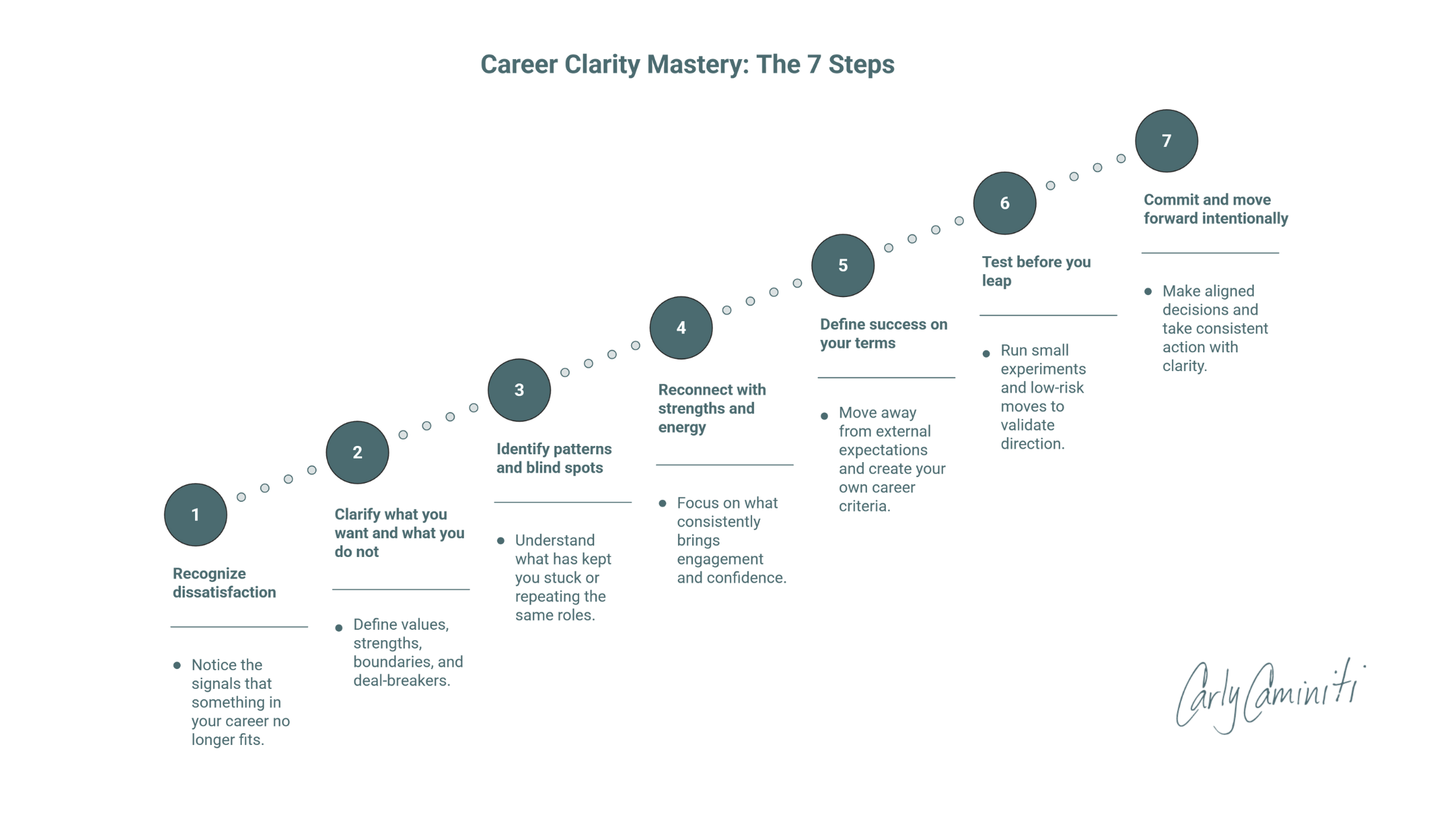
Career clarity mastery transforms professional confusion into confident direction through systematic self-assessment, strategic planning, and consistent action. The seven steps outlined in this career guide provide a comprehensive framework: uncovering genuine drivers, identifying transferable skills, defining non-negotiable values, clarifying career purpose, researching target landscapes, designing strategic plans, and taking consistent action while adjusting course.
Carly Caminiti has guided countless leaders through this exact process, helping them break free from burnout, people-pleasing, and career confusion to design sustainable, fulfilling professional lives. Her expertise in values-driven career development and authentic leadership creates lasting transformation rather than temporary fixes.
The investment in gaining clarity pays dividends throughout your entire career. Making decisions aligned with your authentic self rather than external expectations reduces regret and increases satisfaction. Building on transferable strengths positions you for opportunities you might never have considered.
Start your clarity journey today rather than waiting for perfect conditions. The insights and confidence you'll gain empower better decisions across all areas of professional life. Ready to accelerate your progress with expert guidance? Schedule a complimentary discovery call with Carly Caminiti to explore how personalized coaching can help you achieve the career clarity you deserve.
Frequently Asked Questions About Career Clarity Mastery
What is career clarity and why does it matter? Career clarity means understanding your professional strengths, core values, and authentic motivations combined with a clear roadmap for moving forward. It matters because clarity enables confident decision-making, reduces time wasted in misaligned roles, and increases both satisfaction and success by aligning daily work with your purpose.
How long does it take to gain career clarity? The timeline varies based on your starting point and commitment to the process. Many professionals achieve foundational clarity within three to six months of systematic work including self-assessment, research, and experimentation. However, clarity deepens over time as you gain experience and self-knowledge. Think of it as an ongoing practice rather than a one-time achievement.
Can I gain career clarity without changing jobs? Absolutely. Career clarity often reveals ways to craft your current role for better alignment with your values and strengths before considering external moves. You might adjust responsibilities, build specific skills, or shift your approach to find greater fulfillment. Clarity helps you make informed decisions about whether to stay and reshape or move to new opportunities.
What if I have multiple interests and can't choose one path? Multiple interests are assets, not obstacles. Focus on identifying common threads across your interests rather than forcing yourself into one narrow category. Many fulfilling careers combine different passions in unique ways. Your career purpose statement should be broad enough to encompass multiple interests while specific enough to guide decisions.
How do I know if I need a career clarity coach versus working through this independently? Consider coaching if you've attempted clarity work but remain stuck despite effort, if you're facing a major transition requiring expert guidance, or if psychological barriers like perfectionism or fear consistently block progress. Coaching accelerates the process and helps identify blind spots that self-reflection alone might miss. Research shows that 62% of coachees report positive impact on career opportunities, demonstrating coaching's value for those committed to change.
What's the difference between career clarity coaching and traditional career counseling? Career clarity coaching focuses on helping you discover and articulate your authentic direction through questioning, reflection, and experimentation. Traditional career counseling often emphasizes assessments, job matching, and resume building. Coaching addresses the deeper psychological and strategic elements that enable confident, aligned decision-making rather than just tactical job search support.