
Employee Burnout Solutions: What to Fix When Your Team Runs on Empty
Employee burnout solutions have never been more critical as organizations navigate the persistent challenges of 2026's workplace landscape. With 76% of U.S. workers experiencing some level of burnout and stress levels remaining at decade highs, addressing employee exhaustion isn't just a wellness initiative—it's a business imperative. Carly Caminiti, a professional coach specializing in workplace dynamics and leadership development, emphasizes that effective burnout prevention requires more than surface-level perks; it demands systemic change in how organizations approach workload, communication, and support. Understanding how to implement proven solutions can transform your workplace culture while protecting both your people and your bottom line. For leaders seeking to build healthier teams, exploring comprehensive approaches to team cohesion offers a strong foundation.
Struggling to Build a Burnout-Resistant Team?
Carly Caminiti works with leaders and organizations to develop sustainable workplace strategies that protect people and drive results.
Ready to get started? Connect with Carly today
Also Read:
Table of Contents
TL;DR: Employee Burnout Solutions
Addressing employee burnout requires a multi-layered approach combining organizational policy changes, manager training, and individual support systems. Organizations that implement flexible work structures, establish clear communication channels, train managers in early recognition, and provide robust mental health resources see measurable improvements in retention, engagement, and productivity. The most effective strategies focus on preventing burnout before it escalates by redesigning work structures, fostering psychological safety, and creating sustainable recovery pathways for affected employees. With burnout costing companies between $4,000 to $20,683 per employee annually, investing in comprehensive prevention and recovery programs delivers significant ROI while protecting workforce wellbeing. Success depends on phased implementation, leadership commitment, and continuous measurement of key indicators like absenteeism, engagement scores, and turnover rates.
Key Points: What You Need to Know About Employee Burnout Solutions
Burnout isn't just stress: it's chronic exhaustion paired with cynicism and reduced effectiveness that requires targeted intervention, not just time off
The financial stakes are clear: Organizations with 1,000 employees lose approximately $5 million annually from burnout-related disengagement, turnover, and reduced productivity
Demographic disparities matter: Women experience burnout at rates 8 percentage points higher than men, while Gen Z and Millennials face amplified risks from digital overload and economic pressures
Manager training delivers results: Supportive managers who recognize early warning signs can boost team wellbeing by up to 32% and directly reduce emotional exhaustion
Generic programs fail: Effective solutions require personalized approaches combining organizational policy changes, manager-led interventions, and individual support tailored to recovery phases
Recovery timelines vary: Mild burnout requires 1-3 months for recovery, moderate cases need 3-6 months, and severe burnout may require longer timelines with professional support
Prevention beats crisis management: Organizations that invest in reducing stressors and building resilience skills avoid the costs and disruption of crisis-level interventions
Professional coaching accelerates outcomes: Working with experts who understand both organizational dynamics and individual psychology helps leaders implement sustainable solutions rather than temporary fixes

Understanding Employee Burnout in
Employee burnout in 2026 reflects deeper systemic issues that simple wellness perks can't resolve. While 66% of U.S. employees reported feeling burnout in some form during the past year, the underlying drivers reveal a workplace landscape transformed by hybrid work structures, economic uncertainty, and accelerating digital demands. At its core, burnout is a state of chronic physical and emotional exhaustion where employees lose their sense of purpose and effectiveness at work.
The persistence of high burnout rates despite increased awareness signals that surface-level interventions aren't working. Organizations need to understand both the visible symptoms and hidden root causes to develop meaningful employee burnout solutions.
Key Signs of Burnout in Employees
Recognizing employee burnout signs early allows for intervention before crisis-level situations develop. The most reliable indicators fall into emotional, behavioral, and physical categories that compound over time.
Energy depletion manifests as constant exhaustion that rest doesn't resolve. Research shows 44% of U.S. employees report feeling emotionally drained at day's end, while 51% feel completely used up. This chronic fatigue differs from normal tiredness because it persists despite sleep and breaks.
Mental distance from work appears as cynicism, detachment, and declining motivation. Employees experiencing burnout increasingly question their work's value and withdraw emotionally from responsibilities they once handled with enthusiasm.
Reduced professional efficacy shows up as declining performance, missed deadlines, and decreased confidence. Physical health impacts compound these symptoms, as burned-out employees are 63% more likely to take sick days and 23% more likely to visit emergency rooms.
Leaders seeking to address this emotional withdrawal in their teams can find practical guidance in Carly's resource on overcoming imposter syndrome at work, which explores how self-doubt and disengagement often overlap with burnout patterns.
Reduced professional efficacy shows up as declining performance, missed deadlines, and decreased confidence. Physical health impacts compound these symptoms, as burned-out employees are 63% more likely to take sick days and 23% more likely to visit emergency rooms.
Primary Causes of Workplace Burnout
Digital overload in hybrid setups erodes the boundaries that once separated work from personal life. Constant notifications, back-to-back virtual meetings, and the expectation of perpetual availability leave employees with no recovery time. Research confirms elevated burnout rates among hybrid (57%) and fully remote (61%) workers as digital communication tools transform every location into a potential workplace.
Unrealistic workloads combined with shrinking teams create unsustainable pressure. Economic constraints and labor shortages force remaining employees to absorb additional responsibilities without corresponding support or recognition. When organizations operate with lean staffing models, employees skip breaks, work overtime, and sacrifice quality to meet impossible deadlines.
Poor managerial support amplifies every other stressor. When managers fail to recognize overload signals, provide inadequate feedback, or withhold autonomy, employees feel unseen and undervalued. Toxic management practices increase burnout risk eightfold, making leadership quality the single most influential factor in preventing workplace burnout.
Job insecurity and economic pressures heighten vulnerability, particularly among younger workers. Gen Z workers experience 66% burnout rates, and Millennials face 58% rates as financial strain, restructuring fears, and competitive job markets create constant anxiety.
The Business Impact of Unaddressed Burnout
The financial consequences of ignoring burnout extend far beyond healthcare costs. Organizations face $4,000 to $20,683 in annual costs per burned-out employee when accounting for disengagement, reduced effectiveness, and turnover. For companies with 1,000 employees, this translates to approximately $5.04 million in annual losses.
Turnover driven by workplace stress accounts for 40% of U.S. employee departures, with replacement costs ranging from $4,000 to $21,000 per position. The U.S. economy loses approximately $300 billion yearly in productivity alongside $190 billion in stress-related healthcare expenses. For leaders struggling to maintain team stability, understanding how to set boundaries at work becomes essential for both personal resilience and team sustainability.
Organizational-Level Burnout Prevention Strategies
Preventing employee burnout requires addressing systemic factors rather than placing responsibility solely on individuals. Organizations that redesign work structures, communication patterns, and cultural norms create environments where burnout becomes less likely regardless of individual resilience levels.
Real-World Success: How One Company Cut Director Burnout in Half
A large corporate organization analyzed collaboration patterns of 8,000 employees from January 2022 to March 2023 using Microsoft Viva Insights and Organizational Network Analysis. The company faced critical retention challenges with directors experiencing 25% turnover due to excessive collaborative overload and new associates (≤3 years tenure) facing 26% turnover.
Their data revealed that employees took double the industry average time (2-3 years) to reach peak performance due to poor network integration. The organization implemented targeted interventions including reduced meeting culture with standardized practices, enhanced onboarding to accelerate new employee network building, and leveraged asynchronous communication tools. They piloted solutions in supply chain and North American divisions, resulting in measurable plans to reduce meetings and over-collaboration, directly addressing the burnout and attrition drivers they identified.
Building a Culture That Prioritizes Wellbeing
Culture change starts with leadership modeling the behaviors they want to see throughout the organization. When executives take mental health days, respect boundaries, and openly discuss stress management, they give permission for others to prioritize wellbeing without career consequences.
Recognition and appreciation form the foundation of psychologically healthy workplaces. Employees who feel valued for their contributions maintain higher engagement and motivation even during challenging periods. Establishing formal recognition programs alongside informal appreciation practices helps employees connect their work to meaningful outcomes.
Normalizing mental health conversations reduces stigma and encourages early help-seeking. Organizations should integrate wellbeing discussions into regular meetings, provide mental health literacy training, and ensure leaders can comfortably address emotional challenges.
Creating feedback-rich environments allows employees to voice concerns before frustration escalates to burnout. Regular pulse surveys, anonymous reporting channels, and active listening demonstrate that leadership values employee input and will act on systemic issues.
Redesigning Work Structures and Workload Distribution
Workload management requires honest assessment of capacity versus demands. Organizations must audit current assignments, eliminate low-value tasks, and redistribute responsibilities when teams operate beyond sustainable levels. This means saying no to new initiatives or hiring additional staff rather than stretching existing employees thinner.
Job design should incorporate recovery time into normal workflows. Building buffer periods between projects, scheduling no-meeting days, and protecting focus time allows employees to recharge without falling behind. Structured flexibility in how work gets done gives employees control over their schedules and methods.
Clear role definitions prevent the expansion of responsibilities without corresponding adjustments to other expectations. When job descriptions accurately reflect actual work and organizations resist adding "other duties as assigned," employees can plan their capacity and set appropriate boundaries.
Establishing Clear Communication and Expectations
Ambiguity about priorities, deadlines, and success criteria creates unnecessary stress. Managers should articulate what matters most, provide context for decisions, and update expectations as circumstances change. Transparency about organizational challenges allows employees to understand pressures without feeling personally responsible for systemic issues.
Communication channels need clear protocols about response times and after-hours contact. When organizations establish that evenings and weekends are truly off-limits except for genuine emergencies, employees can disconnect without anxiety.
Regular team meetings create space for coordination, problem-solving, and connection beyond task management. When teams gather to address challenges collectively rather than leaving individuals to solve problems in isolation, the cognitive and emotional load distributes more evenly.
Implementing Flexible Work Policies That Actually Work
Flexibility that exists on paper but carries subtle penalties in practice doesn't prevent burnout. Organizations must examine whether employees who use flexible arrangements face slower advancement, exclusion from key projects, or informal criticism that discourages utilization.
Remote work options, flexible hours, and compressed workweeks should accommodate different life circumstances without requiring elaborate justification. Simple, accessible processes for requesting flexibility signal trust and respect for employees' ability to manage their responsibilities.
Autonomy over work methods and schedules ranks among top protective factors against burnout. When employees control how and when they complete tasks within reasonable parameters, they experience higher engagement and lower exhaustion.
Leveraging Technology and Tools for Burnout Prevention
Digital wellbeing tools like mindfulness apps, guided stress management programs, and mental health platforms provide accessible support between formal interventions. Organizations should subsidize evidence-based tools rather than expecting employees to navigate options independently.
Communication platforms need thoughtful configuration to prevent notification overload. Setting organization-wide norms about response expectations, using status indicators effectively, and scheduling send times for non-urgent messages protects focus time and recovery periods.
Analytics tools can track key burnout indicators like overtime patterns, meeting density, and collaboration overload. When organizations monitor these metrics at the team level, they can intervene proactively before individual burnout reaches crisis levels.
Need Help Designing a Burnout Prevention Strategy for Your Organization?
Carly Caminiti partners with leaders to build sustainable workplace systems that address burnout at every level, from policy to culture.
Let's build something that lasts. Explore team coaching with Carly

Manager-Led Solutions for Preventing Employee Burnout
Managers serve as the primary buffer between organizational demands and employee wellbeing. Their daily interactions, decisions, and support practices determine whether burnout prevention strategies succeed or remain theoretical policies that don't translate to lived experience.
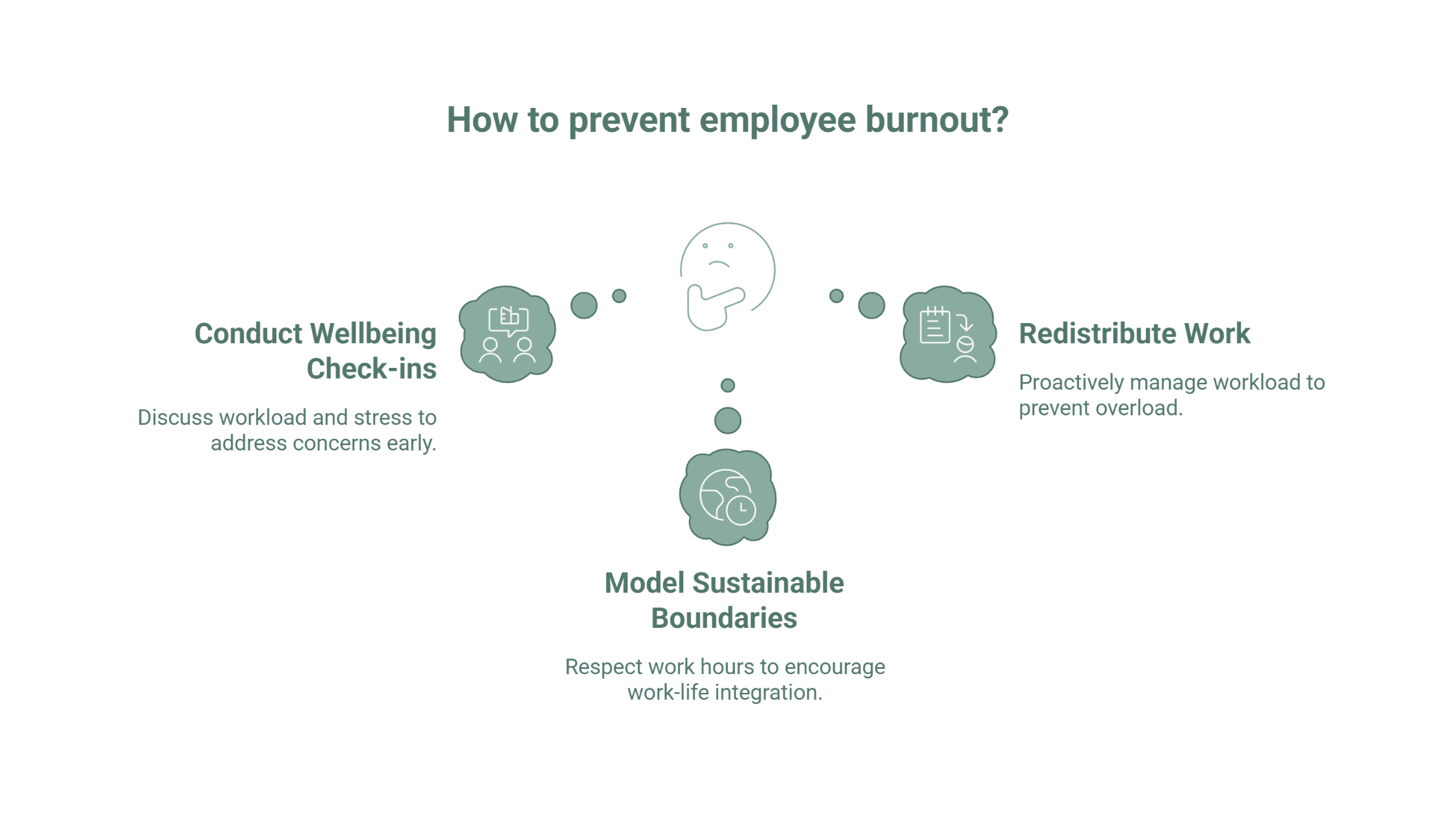
Top 3 Ways Managers Can Prevent Employee Burnout
Conduct weekly one-on-ones focused on wellbeing alongside performance: Managers should dedicate time in regular check-ins to discuss workload, stress levels, and obstacles rather than only reviewing deliverables. These conversations create space for employees to voice concerns before reaching breaking points while demonstrating that their mental health matters as much as their output.
Set and model sustainable boundaries around work hours: When managers send emails late at night or schedule weekend meetings, they signal that constant availability is expected regardless of stated policies. By respecting their own boundaries and explicitly encouraging team members to disconnect, managers give permission for healthy work-life integration.
Redistribute work proactively based on capacity monitoring: Rather than waiting for employees to request help or hit crisis points, managers should continuously assess workload distribution and make adjustments. This might mean delaying non-critical projects, securing temporary support, or pushing back on unrealistic demands from senior leadership.
Training Managers to Recognize and Address Burnout Early
Manager development on burnout recognition delivers measurable outcomes. Gallup's research shows ongoing manager development increases manager thriving levels from 28% to 34%, with further gains to 50% when paired with active encouragement, reducing burnout risk through enhanced leadership effectiveness.
Training should cover physical signs like chronic fatigue and frequent illness alongside behavioral changes like withdrawal, cynicism, and declining quality. Managers need frameworks for distinguishing temporary stress from chronic burnout patterns that require intervention.
Coaching conversations require skills beyond traditional performance management. Managers should learn active listening techniques, how to ask open-ended questions about wellbeing, and when to escalate concerns to HR or employee assistance programs. For leaders seeking to develop these capabilities, exploring how to choose the best coach provides valuable guidance.
Creating Psychologically Safe Team Environments
Psychological safety allows employees to voice concerns, admit mistakes, and ask for help without fear of punishment or judgment. Leadership training in empathy and communication directly lowers team burnout by fostering these environments where vulnerability isn't penalized.
Managers build psychological safety by modeling vulnerability themselves. Admitting when they feel overwhelmed, acknowledging their own mistakes, and asking for feedback demonstrates that struggling doesn't equal failure. This authenticity gives permission for team members to be honest about their capacity and challenges.
Normalizing burnout conversations in team meetings removes stigma and establishes wellbeing as a shared responsibility. When managers regularly ask how everyone is managing workload and discuss stress management strategies openly, they create cultures where preventing workplace burnout becomes everyone's priority.
Setting Sustainable Performance Standards
High performance and sustainable workload aren't mutually exclusive, but many organizations conflate intensity with effectiveness. Managers should distinguish between genuinely urgent priorities and artificial urgency that creates constant crisis mode.
Performance expectations must account for realistic capacity including time for deep work, collaboration, administrative tasks, and recovery. When standards assume employees can operate at peak intensity continuously without breaks or buffer time, burnout becomes inevitable.
Regular performance conversations should address not just what employees accomplish but how they're managing the load. Celebrating efficiency and boundary-setting alongside output reinforces that managing employee stress matters as much as hitting targets.
Conducting Meaningful Check-Ins and Feedback Sessions
Check-ins become meaningful when managers listen more than they talk and focus on understanding rather than immediately problem-solving. Employees need space to process stress and feel heard before jumping to action plans.
Feedback sessions should address systemic barriers to performance, not just individual skill gaps. When employees struggle due to unclear priorities, inadequate resources, or impossible workloads, coaching them to work harder only accelerates burnout.
76% of employees with understanding managers report consistent engagement and motivation. This understanding comes from regular conversations where managers demonstrate genuine interest in employee wellbeing and take action on concerns raised.
Individual Support Solutions for Employees Experiencing Burnout
While organizational and manager-led strategies address systemic causes, employees experiencing burnout need targeted individual support to recover and build resilience. These solutions work best when integrated with broader prevention efforts rather than serving as the sole response.
Providing Access to Mental Health Resources
Employee Assistance Programs (EAPs) deliver confidential counseling and support when properly implemented and promoted. 79% of EAP referrals now focus on mental health counseling, up from 71% in 2023, reflecting both rising needs and growing awareness of these services.
Organizations see $2.30 return for every dollar invested in behavioral health services through reduced medical claims, decreased absenteeism, and improved performance. Some research documents $3 to $10 in productivity gains per dollar invested, making mental health support not just ethical but financially sound.
Access alone isn't enough; organizations must actively promote resources, reduce stigma around utilization, and ensure employees understand how to access support confidentially. Regular communication about available resources and manager training on making appropriate referrals increases utilization rates significantly.
Offering Professional Development and Growth Opportunities
Burnout often stems from feeling stuck or underutilized rather than overworked. Professional development opportunities that align with employee interests and career goals can reignite motivation and provide perspective beyond daily frustrations.
Learning and skill-building create cognitive breaks from routine stressors while investing in future capabilities. When organizations support training in areas employees choose rather than only company priorities, they demonstrate respect for individual growth and long-term career development.
Mentorship and coaching relationships provide support, perspective, and guidance that help employees navigate challenges more effectively. Working with professionals who understand workplace dynamics can accelerate recovery from burnout while building resilience. Carly Caminiti's team coaching approach emphasizes both individual growth and collective resilience.
Supporting Work-Life Integration and Boundaries
The language has shifted from work-life balance to integration, acknowledging that strict separation isn't always possible or desirable. However, integration requires conscious boundaries rather than allowing work to consume all available time and mental space.
Organizations should encourage employees to use paid time off fully and respect vacation boundaries by ensuring adequate coverage. Research shows employees who take regular breaks return with restored energy and creativity rather than continuing on a downward exhaustion spiral.
Flexible scheduling allows employees to accommodate personal responsibilities, health appointments, and recovery activities without sacrificing career progression. When employees can attend therapy, exercise, or handle family needs without anxiety about professional consequences, they maintain better overall wellbeing.
Implementing Employee Assistance Programs Effectively
EAP effectiveness depends on more than just offering access. Programs must provide timely appointments, quality providers, and sufficient session limits to address complex issues rather than only offering crisis triage.
Organizations with comprehensive EAP benefits report 8% higher ROI and 13% increases in employee engagement overall. These gains come from integrating EAPs with broader wellness initiatives rather than treating them as isolated benefits.
Regular measurement of EAP utilization, satisfaction, and outcomes allows organizations to refine services and address gaps. Anonymous feedback about barriers to access helps remove obstacles that prevent employees from seeking support when needed.
Implementing Your Burnout Prevention Strategy
Moving from assessment to action requires strategic planning that secures resources, builds buy-in, and creates sustainable change rather than temporary initiatives that fade when attention shifts.
Creating a Phased Rollout Plan
Starting with pilot programs in high-need departments allows for testing, refinement, and proof-of-concept before organization-wide rollout. Early successes build momentum and provide evidence for scaling investments.
Primary prevention through policy changes and workload redesign should launch first, addressing root causes of burnout. Implementing flexible schedules, no-meeting days, and after-hours communication boundaries creates immediate relief while signaling serious commitment.
Secondary prevention via recovery supports and skills training follows once structural changes are in place. Offering mindfulness programs, stress management workshops, and manager coaching builds individual and team resilience within healthier systems.
Tertiary prevention through EAP access and crisis support completes the ecosystem. Fast-track referrals for employees experiencing severe burnout prevent deterioration while measurement-based care tracks outcomes and informs continuous improvement.
Common Implementation Obstacles and How to Navigate Them
Even well-designed burnout prevention strategies encounter predictable challenges that derail implementation. Understanding these obstacles and preparing responses increases success rates significantly.
Leadership pays lip service but doesn't model boundaries: When executives praise work-life balance while sending midnight emails and taking no vacation, employees receive the real message. Address this by establishing leadership accountability metrics for wellbeing outcomes, incorporating boundary-setting into executive performance reviews, and creating peer accountability groups where leaders commit publicly to modeling sustainable practices. One organization reduced after-hours executive communication by 60% through simple peer commitments and monthly transparency reports.
Flexible policies exist but employees fear using them: Nearly one-third of HR leaders note work-life balance gaps where policies don't match cultural reality. Employees observe colleagues who use flexibility getting passed over for promotions or projects. Combat this by tracking utilization rates by demographic and level, ensuring leadership uses flexible policies visibly, and auditing promotion decisions for hidden bias against those who set boundaries. Anonymous surveys revealing perception gaps between policy and practice provide concrete data for cultural course-correction.
Budget constraints limit quality of support resources: Organizations implementing superficial EAPs or apps without adequate session limits or provider quality see minimal impact. When comprehensive solutions seem financially impossible, prioritize the highest-leverage interventions first. Reducing meeting overload costs nothing but delivers immediate relief. Manager training in workload rebalancing requires modest investment but prevents expensive turnover. Focus resources where data shows the greatest burnout drivers rather than spreading budgets across generic wellness perks that don't address root causes.
Managers lack skills to have difficult conversations: Inadequate manager capabilities mean issues escalate instead of being addressed proactively. Managers trained in recognizing early signs (absenteeism, behavioral changes) but lacking empathy and listening skills either avoid conversations or handle them poorly, increasing employee anxiety. Provide managers with conversation scripts, role-play practice, and ongoing coaching rather than one-off training. Create psychological safety for managers to admit their own discomfort and seek guidance without judgment.
Not all solutions work in all contexts. Organizations with fundamental toxic leadership or severe resource constraints may need structural changes before burnout interventions can succeed. Honest assessment of organizational readiness prevents investing in programs doomed to fail without prerequisite cultural shifts.
Securing Leadership Buy-In and Resources
Financial justification for burnout prevention links to concrete business metrics. Presenting data on turnover costs, productivity losses, and healthcare expenses makes the ROI case that prevention is significantly cheaper than managing burnout consequences.
Leadership must visibly champion initiatives through participation, resource allocation, and consistent messaging. When executives model boundary-setting, use mental health benefits, and discuss wellbeing openly, they give permission for organizational culture shift.
Budget allocation should cover assessment tools, manager training, enhanced EAP services, flexible work technology, and program coordination. Underfunded initiatives that rely on volunteer effort inevitably fail, reinforcing cynicism about organizational commitment.
Communicating Changes to Your Workforce
Transparent communication about assessment findings, planned changes, and implementation timelines builds trust and manages expectations. Acknowledging burnout as a systemic issue rather than individual failing reduces shame and encourages engagement with solutions.
Multiple communication channels reach different audiences and reinforce key messages. Town halls, team meetings, email updates, intranet resources, and manager cascades ensure information reaches everyone regardless of work location or communication preferences.
Ongoing updates about progress, challenges, and refinements demonstrate sustained commitment beyond initial announcement enthusiasm. Celebrating wins, addressing obstacles honestly, and incorporating feedback shows employees their input matters.
Measuring Success and Adjusting Your Approach
Pre- and post-implementation surveys track changes in burnout levels, engagement, and satisfaction. Significant interventions like eight-week mindfulness programs have demonstrated sustained burnout reductions and resilience increases in controlled trials.
Operational metrics including turnover, absenteeism, productivity, and healthcare utilization provide objective evidence of impact. Companies with comprehensive wellbeing programs have reduced turnover by 25-40% through integrated preventive and psychological support.
Regular review cycles allow for rapid adjustment when elements don't deliver expected results. Flexibility to modify approaches based on employee feedback and outcomes data prevents commitment to ineffective strategies.

Managing Crisis-Level Burnout Situations
Despite prevention efforts, crisis situations requiring immediate intervention will occur. Organizations need protocols for rapid response that stabilize individuals, prevent contagion, and address systemic factors that allowed crisis development.
Immediate Triage Steps for HR Teams
One-on-one assessments with affected employees determine severity and immediate needs. Private conversations review workload, emotional state, symptoms, and safety while demonstrating organizational care and beginning stabilization process.
Immediate workload relief through task redistribution, project delays, or medical leave provides space for recovery to begin. Continuing business-as-usual expectations while expecting recovery isn't realistic and typically worsens outcomes.
Fast-track access to EAP counseling, crisis hotlines, or external clinicians ensures employees receive professional support quickly. When internal triage reveals severe symptoms including suicidal ideation or complete functional impairment, immediate professional intervention becomes critical.
Preventing Team-Wide Burnout Contagion
Team-level interventions prevent individual crises from cascading. When one member experiences severe burnout, stress often redistributes to teammates who absorb additional work while processing concern for their colleague.
Structured debriefs after crisis incidents allow teams to process stress collectively rather than individually. Facilitated conversations about workload distribution, support needs, and systemic factors prevent the resentment and exhaustion that fuel contagion.
Workload audits identify whether crisis situations reflect broader team capacity issues. If multiple team members operate near burnout thresholds, organizational intervention must address systemic staffing or expectation problems rather than treating each case individually.
When to Bring in External Support
Complex situations involving multiple affected employees, toxic team dynamics, or leadership burnout require specialized expertise. External consultants provide objective assessment, evidence-based intervention design, and facilitation skills that internal teams may lack.
Organizations should seek outside support when internal efforts haven't produced improvement, when situations involve legal or liability concerns, or when confidentiality needs make internal handling problematic.
Crisis navigation services, workplace psychologists, and organizational development consultants bring frameworks and experience that accelerate resolution. For organizations seeking to understand how professional guidance can transform workplace culture, learning about handling criticism at work offers insights into creating healthier team dynamics.
Building Long-Term Resilience Against Burnout
Sustainable burnout prevention requires embedding wellbeing into organizational DNA rather than treating it as a program that operates separately from core business operations. Long-term resilience comes from continuous attention, adaptation, and cultural integration.
Organizations should establish wellbeing metrics alongside financial and operational KPIs, review them in executive meetings, and hold leaders accountable for outcomes. When burnout rates and engagement scores carry weight equal to revenue targets, preventing workplace burnout becomes strategic priority rather than HR side project.
Continuous learning and adaptation ensure strategies evolve with changing workforce needs and workplace dynamics. Annual review of policies, programs, and outcomes identifies what's working and what needs refinement based on employee feedback and environmental changes.
Cultural transformation happens through consistent reinforcement of values, recognition of wellbeing champions, and integration into systems from hiring through exit. Organizations that successfully embed resilience see reducedturnover of 25-40% alongside higher productivity, innovation, and employee satisfaction.
Frequently Asked Questions About Employee Burnout Solutions
How long does it take to recover from employee burnout? Recovery timelines vary by severity, with mild burnout requiring 1-3 months, moderate cases needing 3-6 months, and severe situations demanding longer periods with professional support. Phased recovery focusing on stabilization, nervous system reset, cognitive restructuring, and sustainable reintegration produces better outcomes than attempting to "push through."
What's the difference between stress and burnout? Stress involves too much pressure and typically improves with rest and support. Burnout represents chronic exhaustion, cynicism, and reduced effectiveness that doesn't resolve with time off alone. Burnout requires addressing both individual recovery needs and systemic workplace factors that created conditions for chronic stress.
Can employees recover from burnout while still working? Yes, but recovery requires workload adjustments, professional support, and organizational commitment to addressing root causes. Employees attempting to maintain full responsibilities while recovering typically experience setbacks and extended timelines. Temporary workload reduction during active recovery phases prevents relapse.
What role do managers play in preventing employee burnout? Managers serve as the primary buffer between organizational demands and employee wellbeing. Training managers to recognize early warning signs, conduct supportive check-ins, and advocate for sustainable workloads can boost team wellbeing by up to 32% while directly reducing burnout risk.
How do I know if burnout is affecting my organization? Key indicators include elevated absenteeism, declining engagement scores, increased turnover particularly among high performers, and decreased productivity. Conducting validated assessments like the Maslach Burnout Inventory alongside analyzing objective metrics reveals burnout prevalence and patterns within specific teams.
What's the ROI of investing in burnout prevention? Organizations see $2.30 return for every dollar invested in behavioral health services, with some research documenting $3 to $10 in productivity gains. Companies implementing comprehensive programs reduce turnover by 25-40% while improving engagement and performance.
Conclusion: Implementing Effective Employee Burnout Solutions
Addressing employee burnout in 2026 demands comprehensive strategies that span organizational policy, manager development, and individual support. With 76% of workers experiencing burnout and costs reaching $5 million annually for mid-sized companies, implementing proven employee burnout solutions delivers measurable returns in retention, productivity, and workplace culture.
Carly Caminiti emphasizes that effective burnout prevention stems from treating it as a systemic organizational challenge rather than an individual resilience issue. Organizations that redesign work structures, train managers in supportive leadership, provide robust mental health resources, and create genuine flexibility see sustained improvements in employee wellbeing and business outcomes.
The path forward requires leadership commitment, phased implementation, continuous measurement, and willingness to address root causes rather than applying superficial fixes. By investing in prevention, supporting recovery, and building long-term resilience, organizations protect their most valuable asset while creating workplaces where people can thrive.
Ready to Build a Workplace Where People Thrive?
Carly Caminiti helps leaders develop comprehensive strategies that address both immediate challenges and long-term resilience across teams and organizations.
Contact Carly today to explore how professional coaching can guide your organization toward sustainable employee burnout solutions that deliver results. Connect with Carly